Breaking

Saturday, 21 February 2026

February 21, 2026

Quieting Noisy Resistors
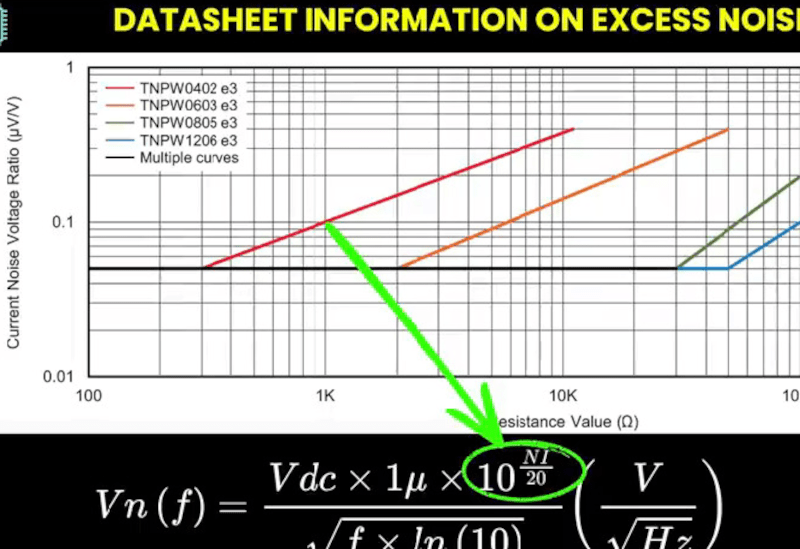
[Hans Rosenberg] has a new video talking about a nasty side effect of using resistors: noise. If you watch the video below, you’ll learn that there are two sources of resistor noise: Johnson noise, which doesn’t depend on the construction of the resistor, and 1/f noise, which does vary depending on the material and construction of the resistor.

In simple terms, some resistors use materials that cause electron flow to take different paths through the resistor. That means that different parts of the signal experience slightly different resistance values. In simple applications, it won’t matter much, but in places where noise is an important factor, the 1/f or excess noise contributes more  to errors than the Johnson noise at low frequencies.

[Hans] doesn’t just talk the math. He also built a simple test rig that lets him measure the 1/f noise with some limitations. While you might pretend that all resistors are the same, the test shows that thick film resistors produce much more noise than other types.

The video shows some rule-of-thumb lists indicating which resistors have better noise figures than others. Of course, resistors are only one source of noise in circuits. But they are so common that it is easy to forget they aren’t as perfect as we pretend in our schematics.

Want to learn more about noise? We can help. On the other hand, noise isn’t always a bad thing.



February 21, 2026

How the Intel 8087 FPU Knows Which Instructions to Execute

An interesting detail about the Intel 8087 floating point processor (FPU) is that it’s a co-processor that shares a bus with the 8086 or 8088 CPU and system memory, which means that somehow both the CPU and FPU need to know which instructions are intended for the FPU. Key to this are eight so-called ESCAPE opcodes that are assigned to the co-processor, as explained in a recent article by [Ken Shirriff].

The 8087 thus waits to see whether it sees these opcodes, but since it doesn’t have access to the CPU’s registers, sharing data has to occur via system memory. The address for this is calculated by the CPU and read from by the CPU, with this address registered by the FPU and stores for later use in its BIU register. From there the instruction can be fully decoded and executed.

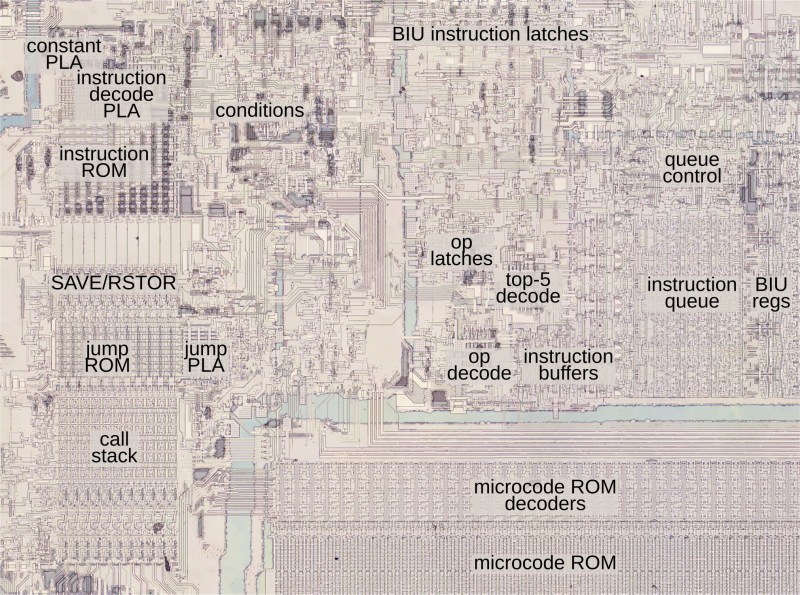
This decoding is mostly done by the microcode engine, with conditional instructions like cos featuring circuitry that sprawls all over the IC. Explained in the article is how the microcode engine even knows how to begin this decoding process, considering the complexity of these instructions. The biggest limitation at the time was that even a 2 kB ROM was already quite large, which resulted in the 8087 using only 22 microcode entry points, using a combination of logic gates and PLAs to fully implement the entire ROM.

Only some instructions are directly implemented in hardware at the bus interface (BIU), which means that a lot depends on this microcode engine and the ROM for things to work half-way efficiently. This need to solve problems like e.g. fetching constants resulted in a similarly complex-but-transistor-saving approach for such cases.

Even if the 8087 architecture is convoluted and the ISA not well-regarded today, you absolutely have to respect the sheer engineering skills and out-of-the-box thinking of the 8087 project’s engineers.


February 21, 2026

Miranda’s Unlikely Ocean Has Us Asking If There’s Life Clinging On Around Uranus

Miranda, as imaged by Voyager 2 on Jan. 24, 1986.

If you’re interested in extraterrestrial life, these past few years have given an embarrassment of places to look, even in our own solar system. Mars has been an obvious choice since before the Space Age; in the orbit of Jupiter, Europa’s oceans have been of interest since Voyager’s day; the geysers of Enceladus give Saturn two moons of interest, if you count the possibility of a methane-based chemistry on Titan. Even faraway Neptune’s giant moon Triton probably has an ocean layer deep inside. Now the planet Uranus is getting in on the act, offering its moon Miranda for consideration in a kinda-recent study in the Planetary Science Journal.

Miranda and Uranus, the new hot spot for life-hunters. 
Photomontage credit NASA.

Even if you’re into astronomy, it may seem like this is coming out of left field. “Miranda, really? What new data could we possibly have on a moon of Neptune nobody’s visited since the 1980s?” Well, none, really. This study relies on reexamining the data collected during the Voyager 2 encounter and trying to make sense of the chaotic, icy world that the space probe revealed.

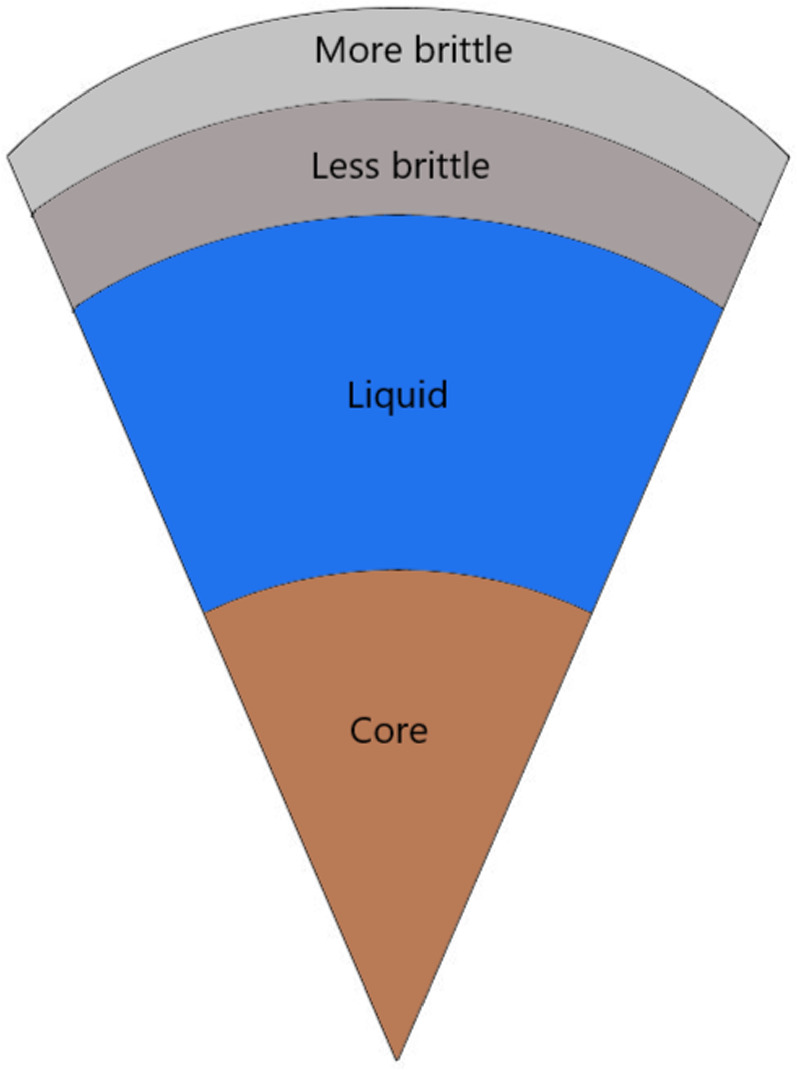
The faults and other features on Miranda indicated it was geologically active at some point; this study tries to recreate the moon’s history through computer modelling to find that Miranda probably had a ≥100 km thick ocean sometime in the last 100-500 million years, and that while some of it has likely frozen since, tidal heating could very well keep a layer of liquid water within the moon’s interior. Since the moon itself is only 470 km (290 mi) in diameter, a 100km deep ocean layer would actually be a huge proportion of its volume.

The model is a fairly simple one, with the ocean sandwiched between two layers of ice and a rocky core. Image from Caleb Strom et al 2024 Planet. Sci. J. 5 226

Right now, the over-optimistic thinking is that “water means life”, since that’s how it seems to work on Earth. It remains to be seen if Miranda, or indeed any of the icy moons, ever evolved so much as a microbe. Aside from the supposed presence of liquid dihydrogen monoxide, there’s nothing to suggest they have. Finding out is going to take a while: even with boots — er, robots — on the ground, Mars isn’t giving up that secret easily. Still, if we’re able to discover irrefutable evidence for such extraterrestrial life, it will provide an important constraint on one term of The Drake Equation: what fraction of worlds develop life. That by itself won’t tell us “are we alone,” but it will be interesting.

Of course, even if all these worlds are barren now, they might not be for long, once our probes start visiting.

Story via Earth.com

Header image: Miranda, imaged by Voyager 2. Credit NASA/JPL-Caltech


Friday, 20 February 2026

February 20, 2026

Electric Jeep With Modified Prius Hardware

On the list of cars widely regarded as the most reliable vehicles ever built, up there with the Toyota Land Cruiser, the Honda Civic, and the Mercedes W123 diesels, is the unassuming Toyota Prius. Although it adds a bit of complexity with its hybrid drivetrain, its design eliminates a number of common wear items and also tunes it for extreme efficiency, lengthening its life and causing minimal mechanical stress. The Prius has a number of other tricks up its sleeve as well, which is why parts of its hybrid systems are often used in EV conversions like [Jeremy]’s electric CJ-5 Jeep.

Inside the Prius inverter is a buck/boost converter used for stepping up the battery voltage to power the inverter and supply power to the electric motor. [Jeremy]’s battery is much higher voltage than the stock Prius battery pack, though, which means he can bypass the converter and supply energy from his battery directly to the inverter. Since the buck/boost converter isn’t being used, he can put it to work doing other things. In this case, he’s using it as a charger. Sending the AC from a standard EV charging cord through a rectifier and then to this converter allows the Prius hardware to charge the Jeep’s battery, without adding much in the way of extra expensive electronics.

There are some other modifications to the Prius equipment in this Jeep, though, namely that [Jeremy] is using an open-source controller as the brain of this conversion. Although this video only goes into detail on some of the quirks of the Prius hardware, he has a number of other videos documenting his journey to convert this antique Jeep over to a useful electric farm vehicle which are worth checking out as well. There are plenty of other useful things that equipment from hybrid and electric vehicles can do beyond EV conversions as well, like being used for DIY powerwalls.


February 20, 2026

Displaying the Rainbow

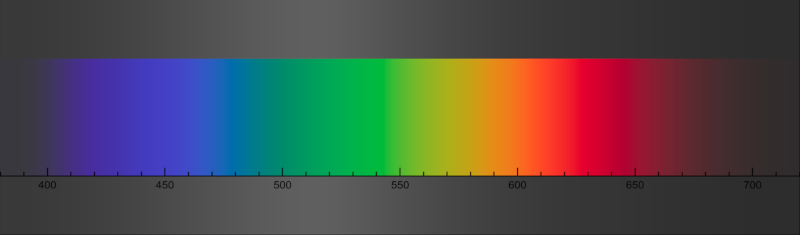
True or false? Your green laser pointer is more powerful than your red one. The answer is almost certainly false. They are, most likely, the same power, but your eye is far more sensitive to green, so it seems stronger. [Brandon Li] was thinking about how to best represent colors on computer screens and fell down the rabbit hole of what colors look like when arranged in a spectrum. Spoiler alert: almost all the images you see of the spectrum are incorrect in some way. The problem isn’t in our understanding of the physics, but more in the understanding of how humans perceive color.

Perception may start with physics, but it also extends to the biology of your eye and the psychology of your brain. What follows is a lot of math that finally winds up with the CIE 1931 color space diagram and the CIE 2012 system.

Some people obsess about fonts, and some about colors. If you are in the latter camp, this is probably old hat for you. However, if you want a glimpse into just how complicated it is to accurately represent colors, this is a fascinating read. You can learn about the Bezold-Brücke shift, the Helmholtz-Kohlrausch effect, and the Abney effect. Maybe that’ll help you win a bar bet one day.

The post winds up in the strangest place: spectroscopy. So if you want to see how color representation applies to analyzing blue sky, neon tubes, and a MacBook display, you’ll want to skip to the end.

We’ve nerded out on color spaces before. In some cases, the right representation is everything.


February 20, 2026

Panoramic Film Camera Made from 3D Printed Parts

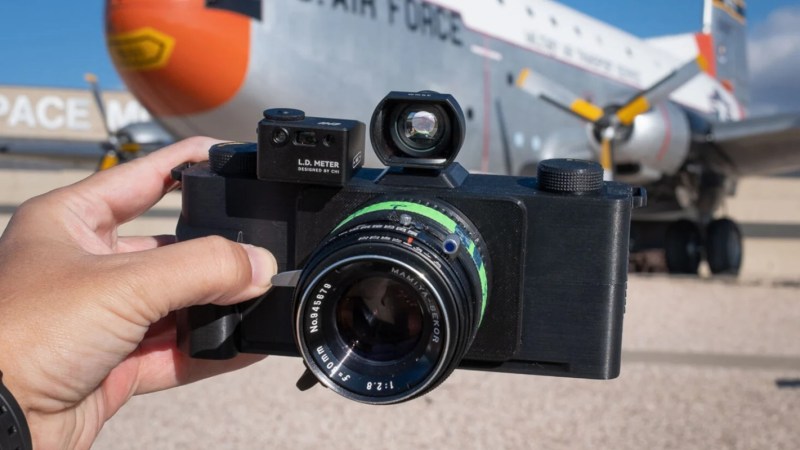
Even though digital cameras have lowered the barrier of entry to photography dramatically, as well as made it much easier for professionals and amateurs alike to capture stunning images without the burden of developing film, the technology behind them is considerably more complex than their analog counterparts. In fact, an analog film camera (not counting the lens) can be as simple as a lightproof box and a way to activate a shutter. Knowing that, any kind of film camera could be built for any number of applications, like this 3D-printed panoramic camera from [Denis Aminev].

The custom-built camera works by taking a standard roll of 35mm film, which is standardized to take 36 pictures, and exposing a wider section of the film to create a panorama. This reduces the number of pictures on the roll to 19. This is the fifth version of this camera, called the Infidex 176 V, and has everything a standard film camera would have, from an exposure counter, pressure plate for the film, a winder, interchangable lenses, a viewfinder, and a tripod mounting point. It does take a bit of work to assemble, as shown in the video linked below, but the final result is impressive and delivers a custom finished product not easily found or reproducible in off-the-shelf cameras.

The path to creating this camera was interesting as well, as [Denis]’s first custom film camera was a pinhole camera. From there he moved on to disassembling an SLR camera and attempting to reproduce all of its parts with 3D printed ones. With that in hand, he was able to modify this design into this panoramic camera which he likes because it reproduces the feel of widescreen movies. Although this camera reproduces all of the bells and whistles of a high quality analog camera, not all of these features are strictly necessary for taking pictures on film. Have a look at this minimum viable camera as well.


February 20, 2026

Porting Super Mario 64 To the Original Nintendo DS

Considering that the Nintendo DS already has its own remake of Super Mario 64, one might be tempted to think that porting the original Nintendo 64 version would be a snap. Why you’d want to do this is left as an exercise to the reader, but whether due to nostalgia or out of sheer spite, the question of how easy this would be remains. Correspondingly, [Tobi] figured that he’d give it a shake, with interesting results.

Of note that is someone else already ported SM64 to the DSi, which is a later version of the DS with more processing power, more RAM and other changes. The reason why the 16 MB of RAM of the DSi is required, is because it needs to load the entire game into RAM, rather than do on-demand reads from the cartridge. This is why the N64 made do with just 4 MB of RAM, which is as much RAM as the ND has. Ergo it can be made to work.

The key here is NitroFS, which allows you to implement a similar kind of segmented loading as the N64 uses. Using this the [Hydr8gon] DSi port could be taken as the basis and crammed into NitroFS, enabling the game to mostly run smoothly on the original DS.

There are still some ongoing issues before the project will be released, mostly related to sound support and general stability. If you have a flash cartridge for the DS this means that soon you too should be able to play the original SM64 on real hardware as though it’s a quaint portable N64.