Breaking

Friday, 18 September 2026

September 18, 2026

Making a Digital Music Player for Cassette Decks
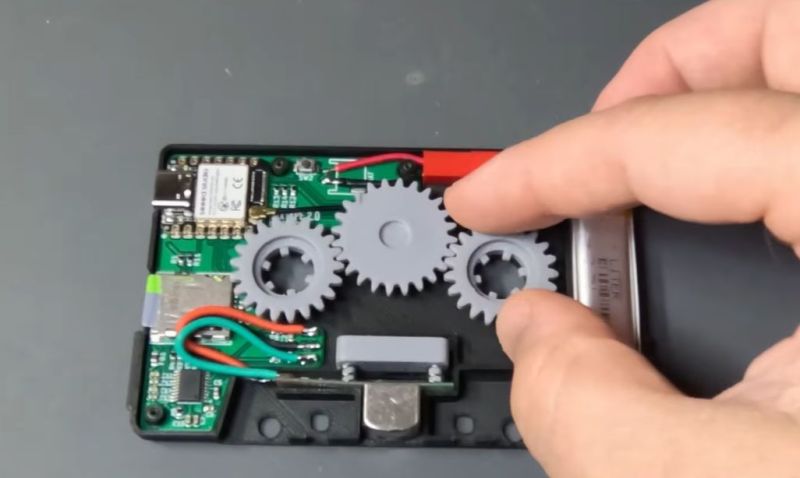
In the cross-over between the era of tapes into that of MP3s, you’d see quite a few of those special cassette tapes that were actually digital music players inside. Some simply provided a 3.5 mm input, while others were complete MP3 players or Bluetooth receivers that just happened to also output to the magnetic read head of a cassette player. Recently [Jonathan Rowny] decided to make his own version of the latter.

Although getting the actual audio signal into the read head is easy enough – requiring little more than its equivalent being used as a write head on the cassette side – actually interfacing with the player’s mechanisms like auto-stop, reverse and so on requires the use of some gearing that detect motion on what would be the tape spools, as well as transfer the motion from the take-up spool to the other spool so that features like the auto-stop mechanism don’t get triggered.

A lot of inspiration here can be found in e.g. the videos made by [Clint] of [Lazy Game Reviews] who looked at a number of examples – including their internals – over the years, with various levels of functionality. For this particular implementation an ESP32-S3 module is used for the brains, along with a microSD card reader for music and a PCM5102 I2S audio codec to create the analog audio signal.

The gears were printed using an SLA printer and seem to work all right. Unfortunately he didn’t realize the importance of the capstan as the mechanism that actually transports the tape, so its motion was not measured as is done in the better cassette adapters. This will likely be corrected in a future iteration, however.


September 18, 2026

Reconstructing a Pin on a Pin Grid Array Package

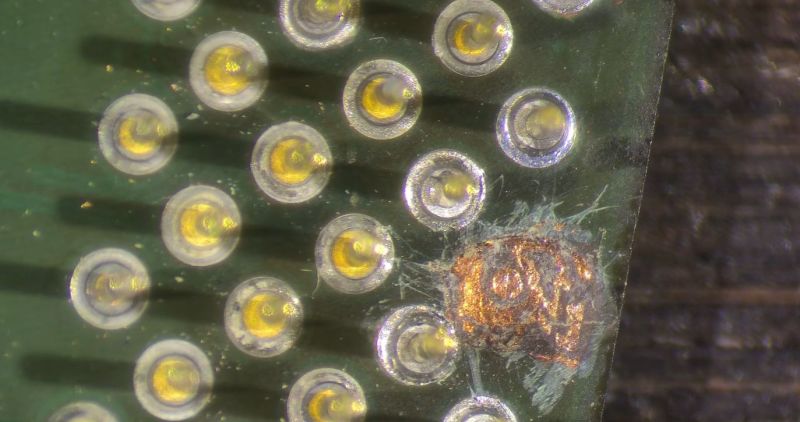
Before moving to land grid array (LGA) packaging whereby each pin on the substrate is just a copper pad, processors commonly used pin grid array (PGA) packaging, including the still highly relevant AMD AM4 socket. With PGA you get a pin soldered onto the copper pad which inserts into the ZIF socket, rather than a fragile pin on the mainboard side. Repairing a damaged PGA pin can be easy if just the pin broke off at the solder joint, or rough if the pad was destroyed, as in the case of this Pentium III CPU that [Bits und Bolts] recently tried to fix.

In the case of something like a ground pin or similarly unimportant pin you can ignore the damage, but in this case it concerned an important pin for this 1.2 GHz Tualatin PIII core, with the damage consisting of a well and truly destroyed pad. The first step to repair the damage is thus to try and rebuild the pad, which was done using solder mask and solder.

Although a PIII-era Celeron CPU is definitely not a high-value CPU, since they have so few and such large pins they do make for useful test subjects when it comes to PGA repair practicing. In this case the affected data pad and pin appears to have been repaired successfully, with it running overclocked to 1.6 GHz and crushing similarly or higher clocked Pentium 4 and AMD Athlon CPUs of the era.


Thursday, 17 September 2026

September 17, 2026

Surveillance Camera Security? It’s Completely Flocked!

Surveillance cameras from Flock Safety have become a controversial privacy battleground, as the communities in which they are installed wake up to their sinister potential, and stories roll in of law enforcement professionals abusing their access. One has had its disk contents dumped, and we’ve been treated to some insights courtesy of [Micah Lee]. In short: their approach to security is deeply flawed.

It’s interesting to find that instead of a custom hardened OS, these devices run Android. Not just Android, but Android 8.1, a long out of support version originally released in 2017. This is is the year Flock Safety was founded, which may or may not be coincidental. Like any old version of a widely used operating system it has a host of known vulnerabilities, none of which are patched on this version.

The Android version is small beer compared to the revelation that they contain a hard-coded and very open-access API key that can be used by any mildly curious miscreant to reveal information from any Flock camera using its MAC address. One would hope that a product marketed for use by law enforcement might have paid attention to such a basic lapse, but it seems not. Whether or not this can be corrected by a software upgrade and the leaked key deactivated without turning off the network depends on whether thy can do upgrades tailored to specific devices, but either way we wouldn’t like to be the team tasked with fixing that one.

In a way it’s reassuring that the surveillance apparatus when it came was so incompetently managed, and we hope that these vulnerabilities will have moderated its effect. We’re sure more tasty discoveries will emerge as investigations proceed, and we’ve got the popcorn ready.

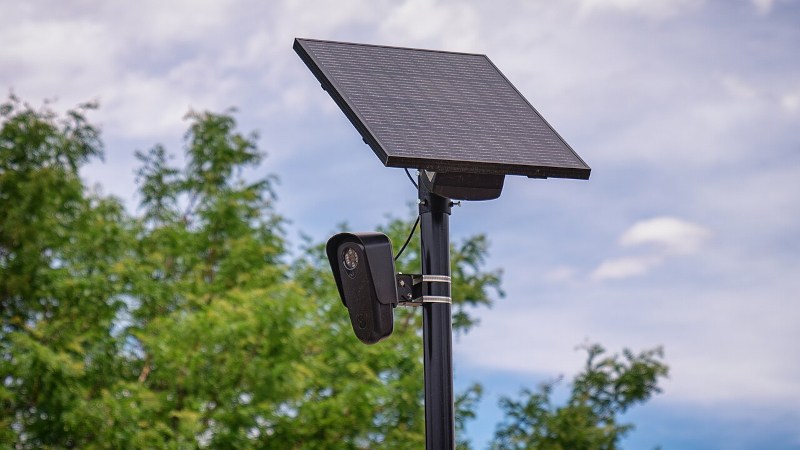
Image: Tony Webster, CC BY 2.0.


September 17, 2026

Your CYD Is Now A Telly

The Cheap Yellow Display is an all-in-one ESP32 board with a touchscreen, that’s as the name suggests, cheap. It’s appeared in a great many projects since it emerged from the depths of AliExpress, and today thanks to [Nickm324] it takes the turn of becoming a mini TV.

The tiny TV project world is one of successive developers building on previous works to deliver their own refinements on the idea, so this one borrows heavily from an earlier ESP32 project. Its twist on the idea is a single button interface using the CYD’s BOOT button. It supports a range of “channels” of which each one is a different piece of media played from the SD card. As far as we can see it’s only able to play synchronised .mjpeg and audio files, probably a shortcoming of the older ESP32 found on the CYD. The photo features a rather cutesy retro 3D printed TV case which annoyingly isn’t linked from the repository at the time of writing.

It’s a nice idea, and the CYD makes it as easy as possible with minimal wiring. Yes it’s a novelty, but we’re guessing there could be many non-novelty applications for it too. It’s certainly not the first such project we’ve seen, here’s an earlier one.


September 17, 2026

Keep Your Back Cool While Others Melt

With an El Niño event in full swing those of us in the northern hemisphere have just had a roasting hot summer, and those in the southern are about to have one. We know what that means, even with the best laid plans the slightest bit of exercise is going to raise a lot of sweat. And if you’re carrying a backpack that means a soaking down your back. Never fear though, because for that one, [Crafterboi] is here with a fan-assisted back protector.

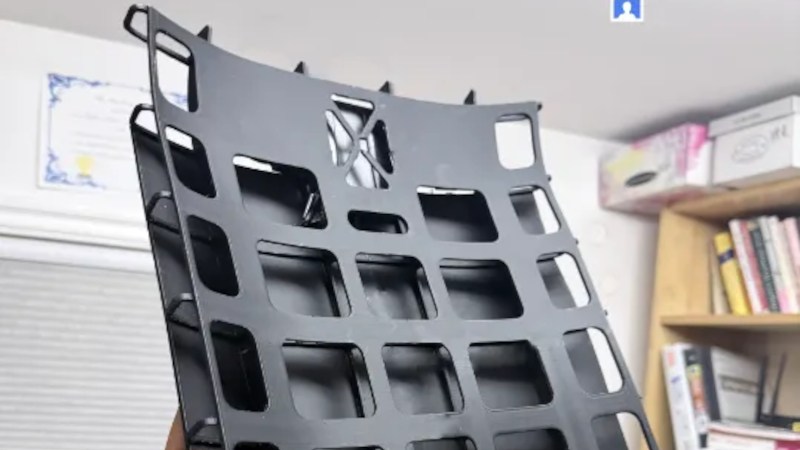
The idea is simple enough, an open framework that sits between you and the backpack, allowing air to flow. If that weren’t enough, there are a couple of 5 volt fans at the top to blow air through the space. It’s printed using PETG, because as he explains, on a really hot day some surfaces can exceed the temperature at which PLA starts to soften.

We like the idea of this project, but what we especially like is that his prototype was made of a pizza box. ten out of ten for resourcefulness! Meanwhile this isn’t the first time we’ve seen a cooling backpack as others have had Peltier systems and evaporative coolers. We would link you to them, but sadly those are both from Hackaday’s early years and link rot has taken their websites.


September 17, 2026

Why Wave Energy is the Final Frontier of Renewable Energy

With the Earth’s atmosphere being effectively just a less dense fluid than the oceans around us, it’s reasonable to ask why we got wind turbines and wind mills quite literally everywhere across the globe to harvest the power in the wind, whereas ocean waves and currents aren’t being exploited quite as much. In a recent video by [Giordano Scarciotti] this issue with wave power is addressed, in particular the massive engineering challenges involved.

Internal view of the CorPower Ocean wave turbine buoy. (Credit: CorPower Ocean)

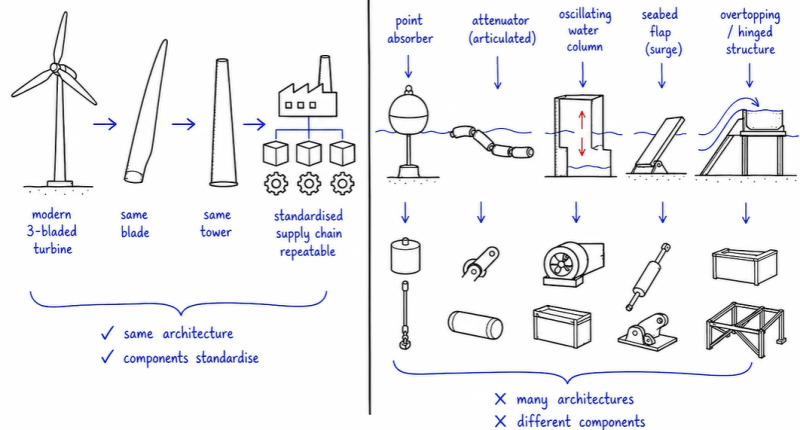
One of the main problems is simply one of cost, with wind energy having converged on a single design involving effectively the same three-bladed rotor, gondola and tower design that has been optimized for decades now. For wave energy there’s no such one-design-fits-all solution, with each attempted design having its own advantages and disadvantages that may prevent it from working in various sites, or incur high maintenance costs in the highly abusive marine environment.

Having more energy in waves than in wind is also both a benefit and a curse, as wave turbines have to work with the waves and not get demolished every time there’s a storm. Even wind turbines regularly fail in windy weather when e.g. the brakes fail, under conditions that would be considered mild in a marine context.

Also covered in the video is a new contender, in the form of CorPower Ocean’s new buoy-like design that bobs up and down on the surface. Here you need to carefully tune the turbine mechanism to work with the wave motion to extract the most energy. Their current design is be 19 meters tall, 9 meters wide and claimed to be capable of being installed in >40 meter deep water, producing power with a 40-60% capacity factor at 300 kW.

As yet another attempt at making wave energy turbines work, the most exciting aspect of it will be to see whether it can survive adverse weather, when careful tuning gets tossed out of the window and chaotic waves pummel what is essentially a very big hollow buoy. The single prototype has so far survived bad weather off the coast of Portugal during a year of testing, but the real test is long-term survival, as losing half your wave turbine farm to a really bad storm every five-odd years would quickly scuttle the project like it has previous commercial contesters.

Although not addressed in the video, the commercial challenge here is also not so much making the power generated over its lifetime (LCoE) economically attractive, but also its system integration cost in terms of required transmission lines, grid-level energy storage and backup power generators like baseload and standby power plants. Without equipping these wave power farms with grid-forming converters as TSOs are asking, dealing with reactive power to absorb and generate it, any resulting grid oscillations exacerbated by grid-following converters risk causing another expensive blackout as recently on the Iberian peninsula.


Wednesday, 16 September 2026

September 16, 2026

Introducing the Periodic Table of US Electrical Receptacles

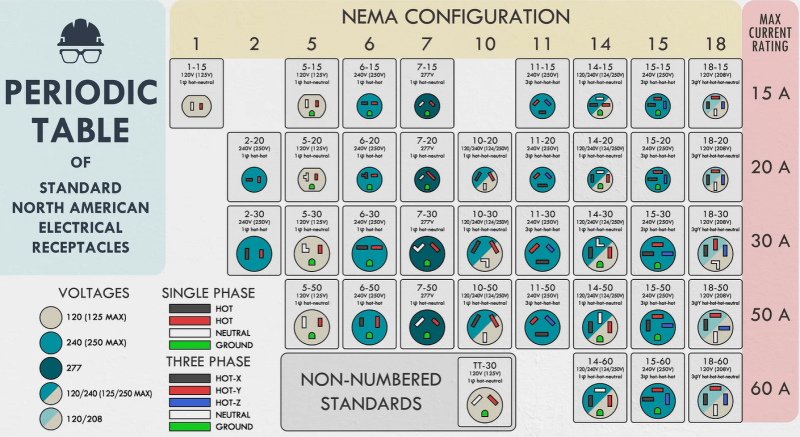
Although things may seem simple on the North American grid as an end-user if you limit yourself to just 120 VAC and NEMA 1-15 and 5-15 connectors, there is a veritable zoo of different voltages and receptacles out there in the NEMA connector catalogue. Recently [Practical Engineering] decided to not only take a look at how many of these defined standards are actually used, but also put them in a nice periodic table style graphic.

Responsible for these standards is the National Electrical Manufacturers Association (NEMA), which as the name says is a collection of manufacturers. Founded in 1926, this US trade association also affects outlet standards in countries like Canada, Mexico, Japan and so on. The caveat here is that compatibility between e.g. a similar looking Japanese 1-15-style plug and a US 1-15 outlet is not guaranteed, even if you ignore voltage and grid frequency differences.

In an ideal world everyone would agree on a set of reasonable connector designs and we could move on, but we live in a world where even today designing your own national connector instead of picking something like the ubiquitous Type F is considered to be reasonable. At least it’s not susceptible to the ‘penny challenge‘ flaw that the NEMA 5-15 connector suffers from, but that’s small comfort.

NEMA connectors are also unique in that they are often polarized, while Type E/F and others rarely are, putting the onus of dealing with AC polarity on the device. This already shows why the NEMA connector diversity exists, as this trade association wanted to have specific connectors for different polarities, different current limits and also the nearly half a dozen of different voltages commonly used throughout the US.

This ‘one connector for a specific combination’ approach means that quite a few of them are not really used in real life, though from a European perspective where you deal with Type C (‘euro plug’) and Type E/F (‘Schuko’)  on ~240 VAC and triple-phase 440 VAC connectors if you run a heavy machine shop or want to fast-charge an EV at home, it’s still a bewildering number of active combinations.