Breaking

Sunday, 11 October 2026

October 11, 2026

Taking A Nokia 3310 Game Jam To The N’th Degree
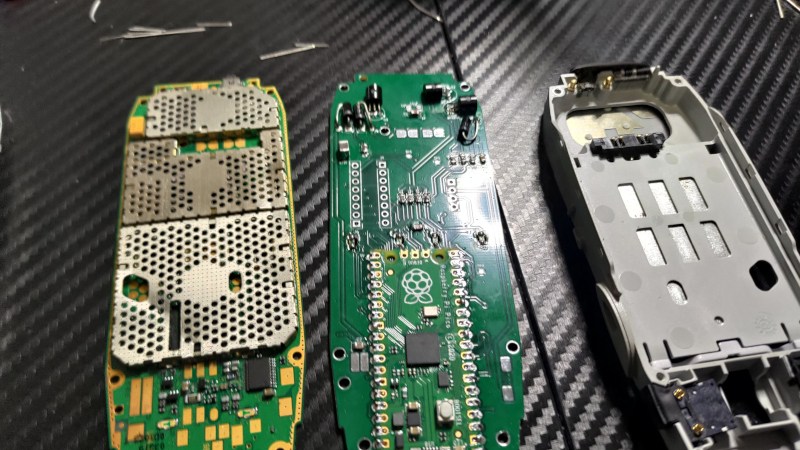
Game jams are a fun competition in which the aim is to write a game under a particular theme while under a time constraint, usually a weekend.  [Hoani] entered one where the aim was to write a game within the constraints of the Nokia 3310’s user interface: a 94 by 48 pixel grey LCD, a buzzer, and a keypad. His entry was Trick Shot II, a ball-bouncing game running on his game engine, which is cool enough, but making a custom PCB for a Nokia 3310 case to run it on? Next level.

Look away if you don’t like restomods, for a real Nokia 3310 is gutted to take this board. On it is a Pi Pico, the Nokia LCD, which has outlasted the original phone as a part by decades, and a Nokia keypad layout. The first prototype was not a perfect fit because it had a 1.6mm board rather than 1mm.

The engine meanwhile is written in Go, and has both graphics and sound APIs. Considering that the Pico’s power exceeds whatever CPU the phone had by many orders of magnitude, we’d imagine it has no problems with such a tiny screen.

We like the attention to detail of this project, and that such a limited interface can still deliver gaming fun. Meanwhile, if you would prefer to use a 3310 as a phone, you can charge it the 21st-century way.



October 11, 2026

Hackaday Links: October 11, 2026

Hackaday Links Column Banner

It probably goes without saying that if you send four humans to observe the Moon up close, they’ll see things that those of us stuck here on Earth have never noticed. Luckily for us, they took impeccable notes and brought plenty of cameras, which NASA has shared with the rest of the class as Artemis II: Sights & Sounds of Science.

Well, technically it’s called the Artemis II Preliminary Lunar Science Report, but we appreciate the space agency adding a little flair to it and formatting the findings for public consumption. Arguably the most significant observations detailed in the report are the impact flashes on the lunar surface. As you may recall, the trajectory of the Orion spacecraft meant the crew experienced a unique solar eclipse on the sixth day of the mission, giving them an unprecedented close-up view of the darkened Moon. During this time, they were able to see flashes of light with their unaided eyes, which NASA has since confirmed were small rocky fragments — perhaps no more than a few inches wide — slamming into the lunar surface at incredible speeds.

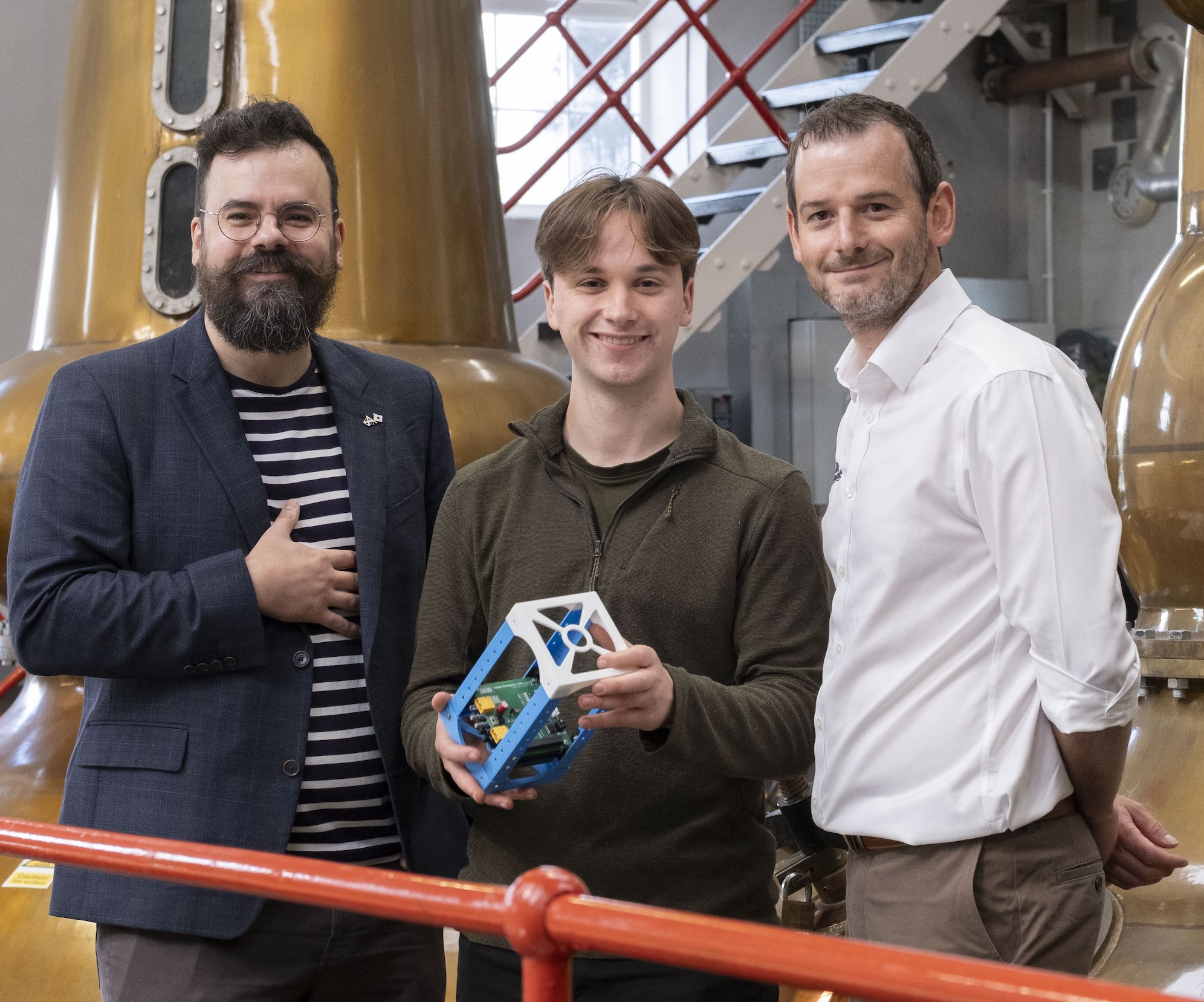
To boldly go where no whisky has gone before.

The Artemis II mission was one for the history books, for most of us the most significant space mission of our lifetimes. But as access to space becomes cheaper and more routine, it stands to reason that not all activities in orbit will be quite so momentous. For example, students from the University of Glasgow and Japan’s Kyushu Institute are currently collaborating on a planned mission to distill whisky in space for the first time.

Scheduled to launch in 2028, the CubeSat will carry 10 ml of fluid and spend five years in orbit studying how its chemical composition changes, with a special interest in how the frequent changes experienced as the spacecraft travels around the Earth could influence the maturing process. While this might not seem terribly interesting to teetotalers, it offers an opportunity to gain more practical experience with orbital manufacturing which will likely inform future missions.

Speaking of studying how things behave — or perhaps how they don’t behave, as the case may be — we have an update on the controversy around this year’s Nikon Small World in Motion competition. After several experts in the field raised the alarm last week, Ning Xu’s winning video supposedly showing cilia in airway tissue samples taken from a child with primary ciliary dyskinesia (PCD) has been disqualified for using generative AI. This shifted all the previous winners up a rank, so Nguyen Nam Nhat of Vietnam now takes the top spot with a video of a roundworm and a single-celled Dileptus.

According to experts, Dr. Ning Xu’s entry was literally too good to be true.

Xu had previously claimed that AI was only used for post-processing the original images, which would have already put the entry into something of a gray area as far as the competition was concerned. But according to researchers familiar with PCD, the structures shown in the video don’t look like anything they’d ever seen in a patient, prompting suspicion that the admittedly fascinating visuals were actually the result of an AI hallucination.

Finally, on the subject of beautiful images, we’d like to point you to ascii.rest. As you’ve probably noticed, we appreciate minimal web design around these parts, so this collection of ASCII animations and art immediately caught our eye. Some of the pieces, like “aurora fjord” shown here, can be exported as a GIF or video clip. But there’s also the option to embed them in your HTML with a couple of lines, which also gives you the opportunity to customize and manipulate them in various ways. If you do anything cool with these designs, we’d love to see it.


See something interesting that you think would be a good fit for our weekly Links column? Drop us a line, we’d love to hear about it.


October 11, 2026

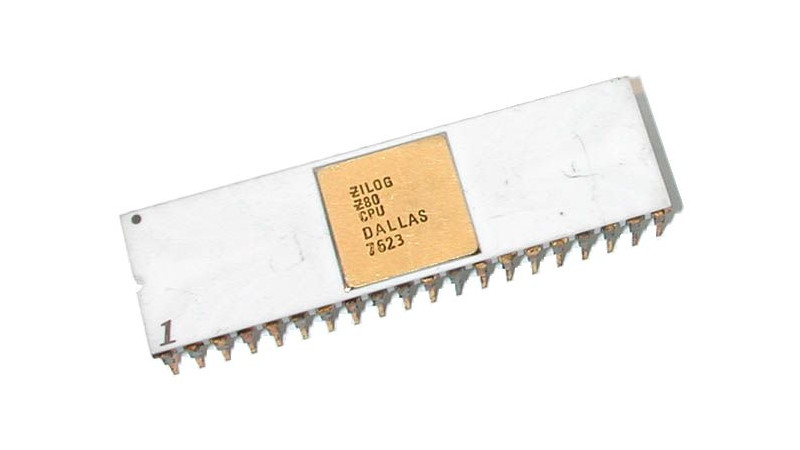
Littelfuse Announces Retirement of the EZ80

Although the demise of the Zilog Z80 processor has long been predicted, it would seem that this moment has finally arrived. The owner of the Zilog name – Littelfuse – recently sent out PCN ZAC26-0074, notifying customers that they will be taking final orders for the eZ80 and all other microcontroller lines that they currently own.

Over at Mouser, eZ80 parts have correspondingly all been marked as “End of Life”. This comes a few years after the original Z80 and its peripherals were discontinued, with the eZ80 still being an alternative until now.

Any potential sellers will have to put in their orders today, with orders still accepted until December 21 2026, with final deliveries taking place throughout 2027 as Littelfuse winds down its MCU manufacturing. This means that for commercial customers are least this is pretty much the end of the road for any circuit that still uses the eZ80 or similar.

Many of us have fondness for the Z80, which also has led to a potential way that the Z80 can live on. This includes both the many open source cores that are compatible with the Z80, as well as real silicon courtesy of the TinyTapeout project.

Thanks to [Techokami] for the tip.


Saturday, 10 October 2026

October 10, 2026

Slim Type for Small Screens, with PixelFonts

Small displays are affordable and easy to use, but their size can present a challenge. To help address this, [mcer12] created PixelFonts, a family of condensed fonts designed specifically for low-resolution displays, making sure every line holds as much text as it can fit.

PixelFonts works alongside either the AdafruitGFX or U8g2 libraries; one writes to the display using the common syntax of the chosen library, and the font itself comes from PixelFonts. Text can be displayed in regular and 3D shadowed versions, as well as in a wide variety of heights and weights. There’s support for accented letters, albeit only in lowercase due to space constraints. Want to make some changes? Every font comes with a BDF file to make alterations as widely accessible as possible.

Making the most of every pixel is important with small displays, but there’s more than one way to do so. For example, when it comes to color LCDs, subpixel rendering can improve legibility of small fonts; another way to get the most out of limited display sizes.


October 10, 2026

Unique Archeological Discovery Sheds Light on Neanderthal Wooden Tool Usage

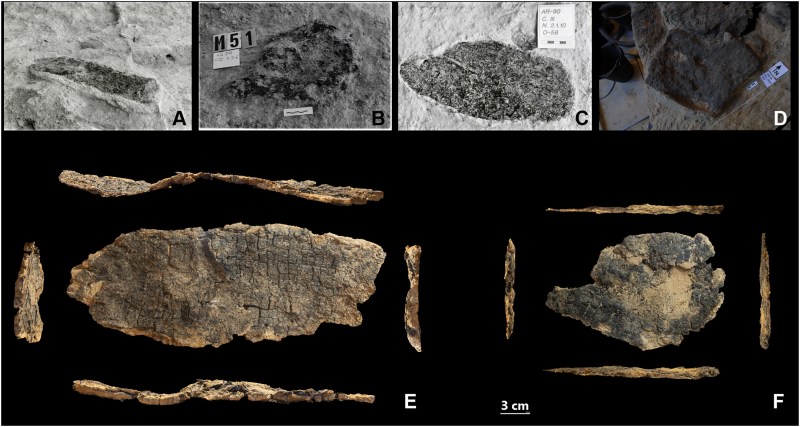
The Abric Romaní site in Spain is rather unique in archeology for one simple reason: the caves in its limestone-rich cliff have seen humanoid occupation for thousands of years. A thick layer of calcium carbonate-based travertine deposit has, over time, covered and largely preserved tools and other implements, including those made of wood. Over many decades of archeological exploration, 597 wooden imprints have been uncovered, with a recent research article by [Palmira Saladié] et al. detailing these findings.
Wood is one of those archaeological artefacts that are very elusive due to their fragility, even though we know that wood has been used pretty much everywhere from the first day that a humanoid critter discovered that branches make great clubs and spears, and can also easily be shaped to make them even more useful.

The wooden imprints and some larger remains of wooden implements were found, ranging from wooden spears and clubs to trays (see heading image) and tripods. With enough of the wood still present, researchers were also able to determine which types of trees were used to make these tools, and sometimes which part of the tree.

These finds date back to between 62,000 and 40,000 years ago during the Middle Paleolithic era. This would have been around the time that Homo sapiens began to move into Europe, with both species of humans living side by side for thousands of years. These days, the only active traces of this can be found in our DNA, which retains bits of H. neanderthalensis.

The supplemental materials PDF  breaks down some of this site’s more recent history. The sole reason that this crucial archaeological site was discovered was that the landowner in the early 20th century expressed a profound interest in archaeology and other natural sciences.

Thanks to this lucky find, we gained some insight into how our ancestors would have learned how to create crude wooden implements, before eventually moving on to smelting metals and eventually sand in order to make it into computer chips.


October 10, 2026

Poking at the Radxa Dragon Q8B Raspberry Pi 5 Killer

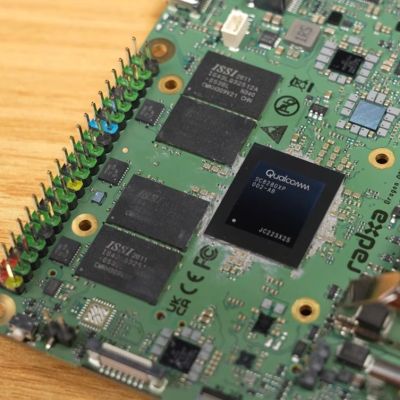
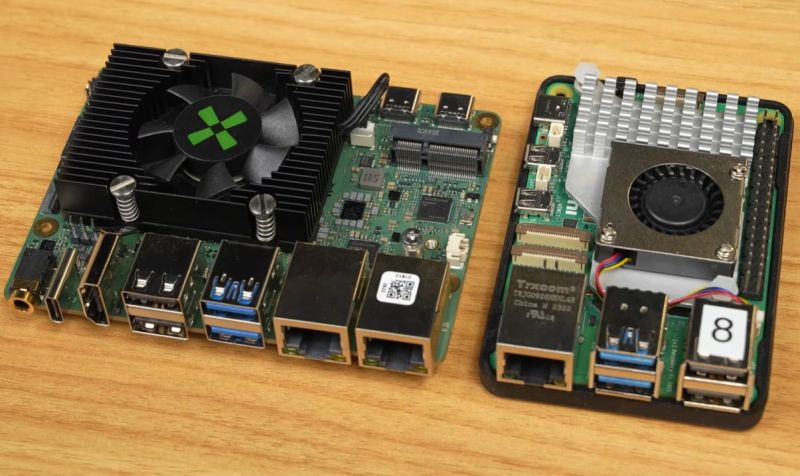
Although the asking price of $209 plus shipping seems high for the Radxa Dragon Q8B, featuring the Qualcomm SC8280XP and 8 GB of LPDDR4X, this is 2026, and amid the RAMpocalypse, even the 8 GB LPDDR4X-equipped Raspberry Pi 5 now costs $175. This, to [Jeff Geerling], makes it fair to directly compare the two to see whether you may want to consider this board for more intense computing purposes.
There’s also a written summary of the results and details in a GitHub issue, though the direct comparison with the Raspberry Pi 5 is in the video.

Although this Qualcomm SoC isn’t new, its primary use is for Windows laptops, which gives somewhat of a hint as to what its performance may be like, tempered by the fact that it was announced in 2021.

The Dragon QXB offers about 2x everything over the RPi5, plus Windows and UEFI support. For Linux, it appears that you still need customized images, which seems perplexing in light of the UEFI aspect. You also have to pick between different Linux images from Radxa and use their Rsetup update tool, making it a less than ewbie-friendly offering.

The Radxa-provided Linux experience is somewhat choppy. Raw performance in e.g., Geekbench 6 multi-core shows why you’d want to use this SBC, as it triples the RPi5 score. Power efficiency is also better, with [Jeff]’s HPL efficiency showing 3.73 Gflops/W versus 2.75 for the RPi5. There are twin 2.5 Gbit Ethernet ports and more PCIe too, all of which can really be used by the raw CPU power.

This means that there’s a lot to like about this Q8B SBC. [Jeff] expresses his appreciation for it, despite issues with the Radxa UEFI BIOS. It feels like Radxa is still trying to work out the BIOS-related kinks, which might even allow for the installation of generic OS images, rather than their own images.

Per the documentation, the SBC comes in a range of RAM sizes, from 4 to 32 GB, so you can still get a cheaper version too, if you can find one for sale. As noted in the video, these SBCs are still pretty scarce, and as the AI-induced personal computing and SBC collapse continues, this situation is unlikely to improve.


October 10, 2026

Valve Releases Hardware and CAD Reference For New VR Headset

Valve recently began shipping its long-awaited VR headset, the Steam Frame. Now, there is a hardware reference repository that includes everything a budding modder might need, and then some.

No need to 3D scan or break out the calipers if one wants to design their own add-ons.

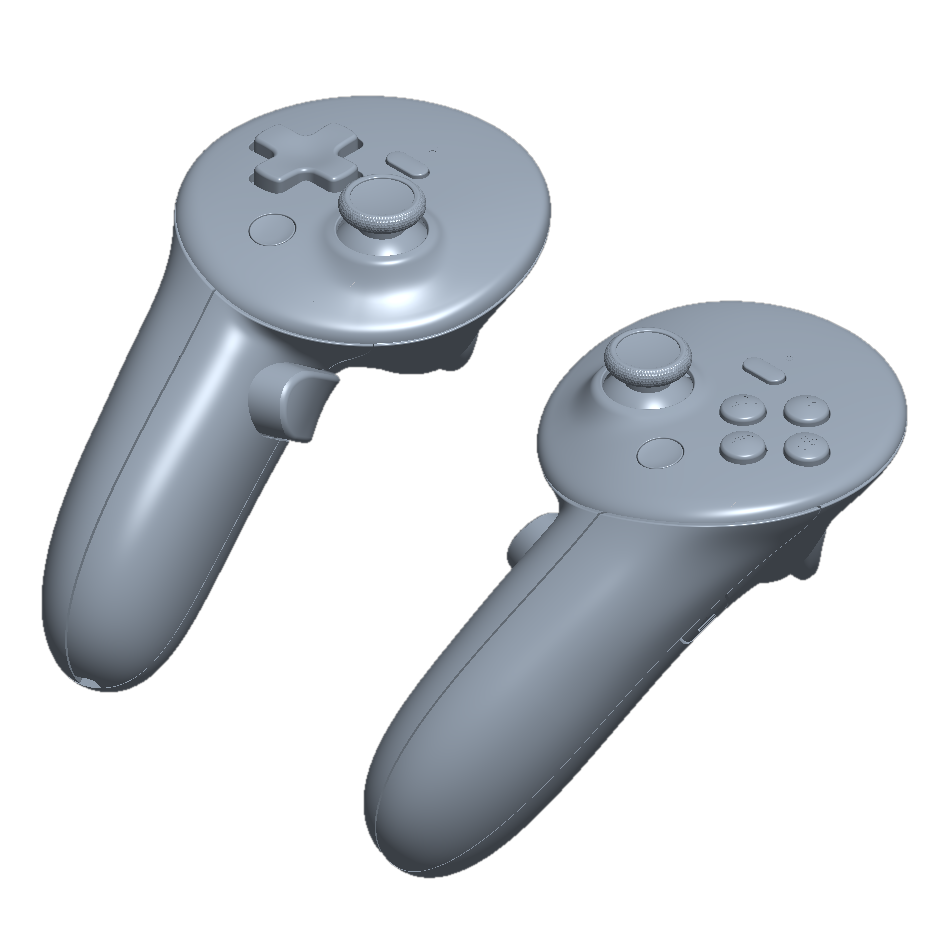
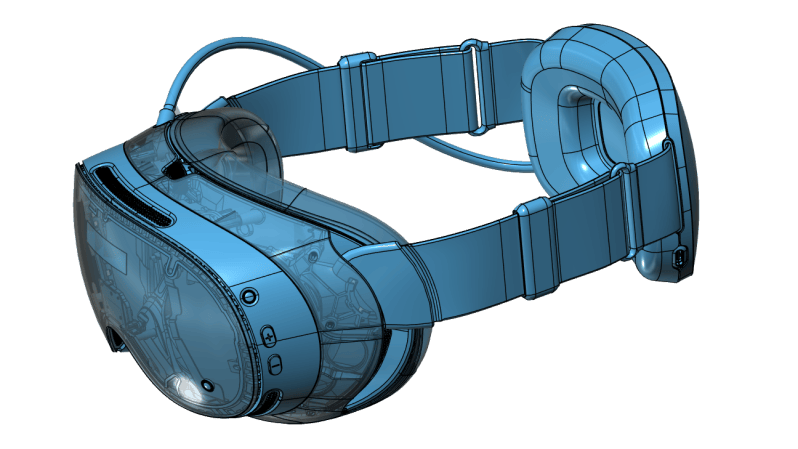
Want to design and 3D print some add-ons, or a carrying case, or some other doodad? There’s no need to break out the calipers or 3D scan the hardware. The repository contains STEP format models of the VR core module, head strap, and controllers, so it’s as easy as possible to design things that’ll fit. The location of the IR tracking LEDs embedded in the controllers is also documented, so one can ensure their design doesn’t occlude them.

That’s not all. The Frame has a user-accessible hardware expansion port at its front. This port exposes two interfaces: high-speed MIPI camera and PCI Express. This expansion port is documented in the repository, and even has a simple reference design built in both KiCad and Altium.

We’re glad to see Valve maintain their hacker-friendly hardware design with the Steam Frame. Demand for The Frame outstrips supply so far, so if you’re on the waitlist, you might want to browse the repository and get an early start on whatever customizations you have in mind while you wait for your confirmation. And when you get something working, drop us a note on the tips line!