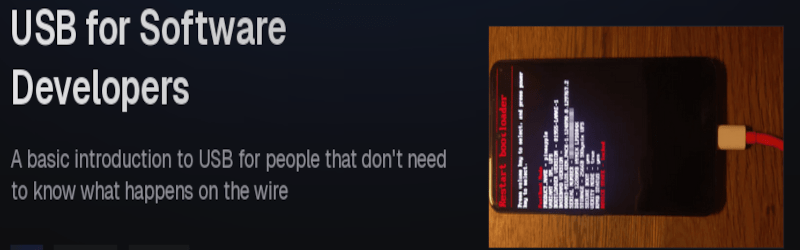
Modern technology builds on abstractions. Most application programmers today don’t know what a non-maskable interrupt is, nor should they have to. Even fewer understand register coloring or reservation stations for instruction scheduling, and fewer still can explain the physics behind the transistors in the CPU. Sometimes tech starts out where you need to know everything (programming a bare-metal microprocessor, for example) and then evolves to abstraction. That’s where [WerWolv] wants to get you for writing USB code using the recent post USB for Software Developers.
Many USB tutorials assume you want to know about the intricacies of protocol negotiation, information about the hardware layer, and that you are willing to write a Linux kernel module to provide a driver. But thanks to abstraction, none of this has been absolutely necessary for many use cases for a long time.
While the post focuses on Linux, there is libusb for Windows. We presume the same principles would apply, more or less.
Interestingly, the target device for the tutorial is an Android phone in bootloader mode. We thought that was strange at first, until we read the rationale. You can easily get your hands on an Android phone if you don’t already have one. The device is simple. Plus, it is unlikely you already have drivers installed on your system that would interfere with your tutorial driver. Makes sense.
After that, it is pretty straightforward to use libusb to find the phone, determine what you can do with it, and communicate with it. Sure, the phone’s “fastboot” protocol is simple, but that’s just like using a TCP socket. You may implement a fancy protocol on top of it, but that doesn’t mean sockets are hard to use.
We’ve looked at simplified USB drivers before. Of course, for some applications, you can bend a USB serial port to handle something a bit more complex.


 Hello, my name is Riaz and if you want to know more about me just contact me
No comments:
Post a Comment