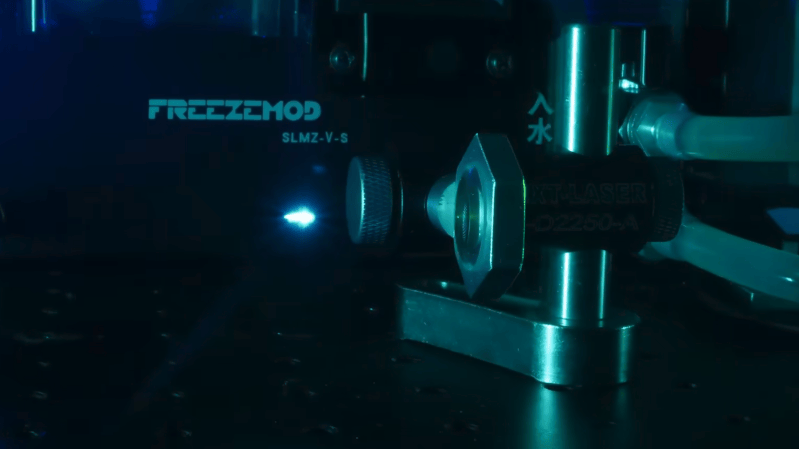
One fascinating thing about a pulsed laser is that, though the average power may be measured in watts or milliwatts, the peak power can easily reach millions of times that. This happens even in normal operation, but as [Les’ Lab] demonstrated, adding a Q-Switch can considerably enhance the peak power.
A Q-switch is an optical attenuator; when placed in the laser cavity, it keeps the cavity from reaching resonance. This greatly limits stimulated emission, allowing energy to build up in the chamber as the gain medium becomes increasingly saturated. Eventually, at some energy level, the Q-switch suddenly stops blocking light, and the cavity lases in a very short, powerful pulse. The Q-switch doesn’t increase the energy in a laser shot, but it does release it much more quickly. In this case, [Les] used chromium-doped yttrium aluminum garnet crystals as the Q-switch and compared performance across several different crystals.
[Les] used two sensors to measure the laser pulse: a pyroelectric energy sensor and a fast photodiode to measure the pulse’s shape. Without the Q-switch, [Les]’s laser produced a pulse about 150 µs long, with a total energy of about 137 mJ and a peak power just under one kilowatt. After adding a Q-switch, the pulse dropped to 14 ns, and the peak power rose to 1.3 megawatts, though the total energy dropped to 77 mJ. [Les] also built an absorption meter and used this to compare several Q-switches with different absorptions; in general, greater absorption increased the peak power when the laser did fire, reaching 2.25 MW at 92% absorption. Increased peak power didn’t translate into greater cutting power, though; when aiming at a metal target, the pulse was too short to do much more than ablate the metal’s surface. The energy output was, however, enough to ionize air or shatter glass at the laser’s focal point.
This isn’t the only enhancement [Les] made to his former tattoo-removal laser; this builds on a previous upgrade to the gain medium itself. For more background on why Q-switches work, check out our article on laser fundamentals.


 Hello, my name is Riaz and if you want to know more about me just contact me
No comments:
Post a Comment